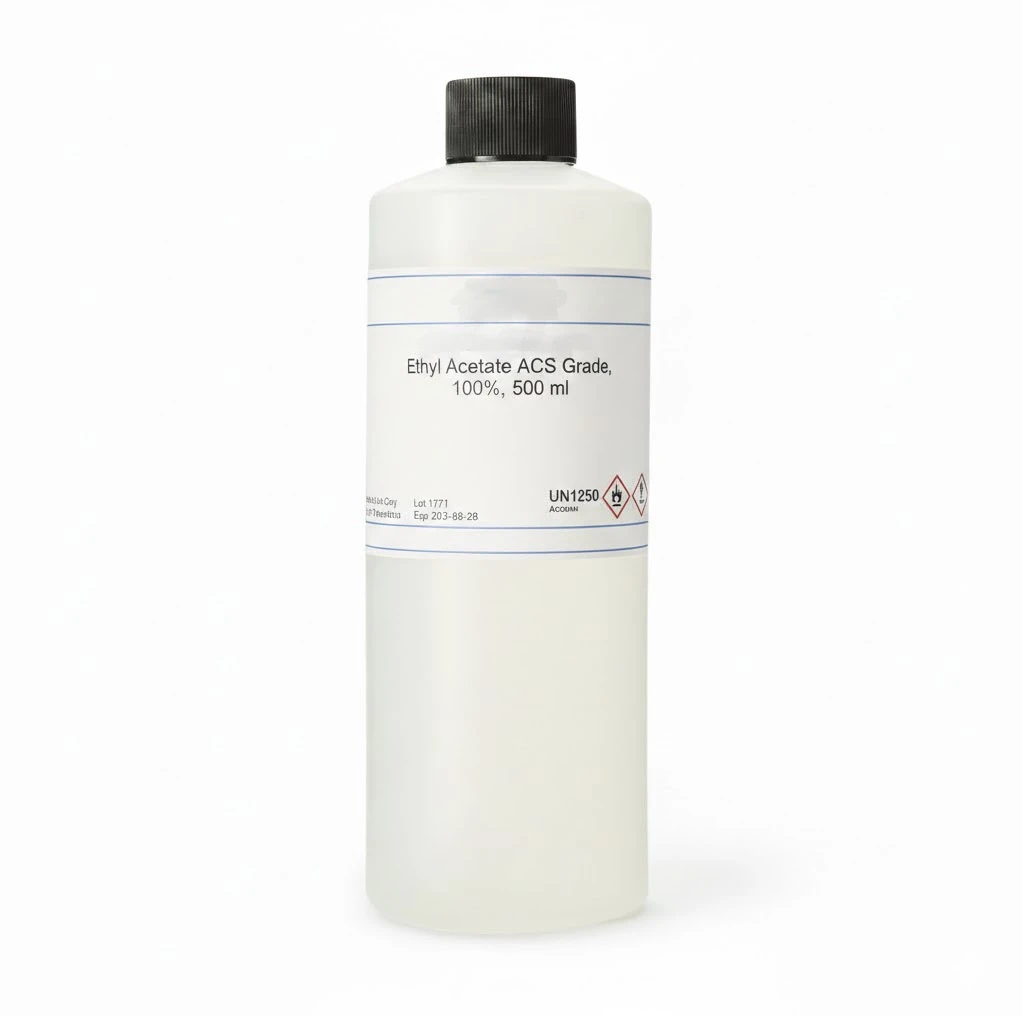
Sepehran Chemistry exports industrial-grade ethyl acetate, C4H8O2 (CAS 141-78-6, HS code 2915.31), from Iran. It is a fast-drying solvent for flexible packaging inks, adhesives, paints and coatings, and a process solvent in chemical manufacturing. We ship in steel drums, IBC tanks, ISO tanks, bulk tankers or customized export packaging, under FOB, CFR or CIF terms. COA, technical data sheet and export documentation are available on request.
Ethyl acetate is a colorless ester with a fruity odor and the formula CH3COOC2H5. It is made mainly by reacting ethanol with acetic acid. It dissolves a wide range of resins, evaporates quickly and has relatively low toxicity, which makes it one of the most used industrial solvents.
Sepehran Chemistry works as a supplier and exporter for ink and adhesive makers, coating producers, chemical plants and distributors. We pack to your requirements, quote on FOB, CFR or CIF terms, and handle export documents and logistics. We also supply methyl acetate and white spirit for coating formulators, as part of our range of wholesale chemicals from Iran.
Ethyl Acetate Product Information
Lot-specific values are given on the Certificate of Analysis, available on request.
| Property |
Value |
| Chemical name |
Ethyl acetate |
| Synonyms |
Ethyl ethanoate, acetic acid ethyl ester, EtOAc, EA |
| CAS No. |
141-78-6 |
| EC No. |
205-500-4 |
| HS code |
2915.31 |
| Molecular formula |
C4H8O2 |
| Molecular weight |
88.11 g/mol |
| Structure |
CH3COOC2H5: ester of acetic acid and ethanol |
| Appearance |
Clear, colorless liquid with a fruity odor |
| Boiling point |
Approx. 77 °C |
| Melting point |
Approx. −84 °C |
| Solubility in water |
Slightly soluble; miscible with most organic solvents |
| Grade |
Industrial grade |
Packaging, Delivery Terms and Documents
- Steel drums: For smaller orders and users without bulk storage.
- IBC tanks: For mid-size orders.
- ISO tanks and bulk tankers: For large-volume buyers with bulk storage.
- Customized packaging: Export packaging made to the buyer's requirements.
- Delivery terms: FOB, CFR and CIF.
- Documents: COA (Certificate of Analysis), technical data sheet and export documentation, available on request.
Request a Bulk Supply Quote
Main Applications of Ethyl Acetate
- Printing inks: Ethyl acetate is a main solvent in gravure and flexographic inks for flexible packaging film, labels and cartons, where fast drying keeps press speeds high.
- Adhesives: It is used in laminating adhesives for flexible packaging, contact adhesives and other solvent-based glues.
- Paints and coatings: It is a solvent in nitrocellulose lacquers, wood coatings, varnishes and industrial finishes.
- Cosmetics: It is a solvent in nail polish and nail polish removers.
- Pharmaceutical and chemical processing: It is an extraction and process solvent in pharmaceutical and fine chemical production. These uses require a pharmaceutical-grade product.
- Food processing: Food-grade ethyl acetate is used to decaffeinate coffee and tea and as a flavoring component. These uses require a food-grade product.
Ethyl Acetate vs Methyl Acetate vs Butyl Acetate
- Ethyl acetate: Boils at about 77 °C. It balances evaporation speed, solvency and low odor, and is the most used acetate solvent.
- Methyl acetate: Boils at about 57 °C, so it dries faster. It is more soluble in water and is VOC-exempt in the United States.
- Butyl acetate: Boils at about 126 °C, so it evaporates slowly. It is used in automotive and industrial coatings where a slower-drying film gives better flow and gloss.
- Acetone: A ketone that evaporates even faster than ethyl acetate and has stronger solvency, but a sharper odor. Formulators often blend the two.
What Affects the Price of Ethyl Acetate
- Ethanol and acetic acid prices: These are the raw materials, so their prices drive production cost.
- Packaging and printing demand: Flexible packaging inks and laminating adhesives are the largest users, so packaging output moves demand.
- Grade: Food and pharmaceutical grades cost more than industrial grade because of purity limits and testing.
- Packaging: Bulk tankers and ISO tanks cost less per ton than IBC tanks or drums.
- Hazardous freight: Ethyl acetate is highly flammable, so it ships as dangerous goods, which adds to freight cost.
- Delivery term and quantity: CFR and CIF prices include sea freight, and CIF also includes insurance. Larger and repeat orders usually get better unit prices.
Frequently Asked Questions
What are the CAS number and HS code of ethyl acetate?
The CAS number of ethyl acetate is 141-78-6. Its 6-digit HS code is 2915.31.
How is ethyl acetate made?
Ethyl acetate is made mainly by esterifying ethanol with acetic acid. Some plants make it from acetaldehyde or from ethylene and acetic acid.
What is the difference between ethyl acetate and methyl acetate?
Ethyl acetate boils at about 77 °C and methyl acetate at about 57 °C, so methyl acetate dries faster. Ethyl acetate is less soluble in water and is the more widely used solvent in inks and adhesives.
Can your ethyl acetate be used in food or pharmaceuticals?
We export industrial-grade ethyl acetate. Food and pharmaceutical uses require a grade that meets the relevant standard. State your end use in the inquiry and our export team will confirm what is available.
How is ethyl acetate packed for export?
We supply ethyl acetate in steel drums, IBC tanks, ISO tanks, bulk tankers or customized export packaging made to the buyer's requirements.
Which delivery terms and documents are available?
We quote ethyl acetate on FOB, CFR and CIF terms. A COA (Certificate of Analysis), technical data sheet and export documentation are available on request.
Request an Ethyl Acetate Export Quote
To get a quote, send us the quantity you need, the end use and any purity requirement, your preferred packaging (drums, IBC, ISO tank or bulk tanker), the destination port and the delivery term (FOB, CFR or CIF). Our export team will reply with a quotation and the documents available for your order. You can also reach us through the contact page.
Chat with Our Export Team